Thanks, Camella and Kevin! Sonny is really into chopping right now, so this was perfect.
Sunday, January 06, 2008


Wednesday, January 02, 2008
Happy New Year
 Alethaire and POK sing and play lead on Alz's original song "Breathe." We had a fun round of pass the guitar on New Year's Eve up at The Farm.


Tuesday, January 01, 2008
The Super Awesome Track

Well, Santa listened, apparently. With any luck, you'll be able to view the trains in action. Here's a picture of the track. Try clicking this link to see the video:
Saturday, December 15, 2007
Sonny and Santa

emeka took Sonny to see Santa tonight. There was a Christmas program at the First Baptist Church, and Santa was going to be there after the show. Well, they made the mistake of announcing that Santa was in the basement, so Sonny was like, "Well, why are we up here?" He told Santa he wanted trains, but he said he forgot to ask what would be in his stocking. He also told me several times that he did not get to eat "one of the cookies that the other folks were eating." But he did eat some chocolate about which he said, "It has all that good caffeine and sugar in it. Daddy said if I eat chocolate, I'll get riled up."
Tuesday, December 11, 2007
Videos
Well, I've posted two videos so far on youtube. My name is burningsage7, so you can search that if you want to see Sonny playing trains and singing (his specialties), but I have yet to figure out how to put a direct link into the blog. I'll get back to you on that. In the meantime, enjoy!
Friday, November 30, 2007
Frost

The world shimmers this morning. Last day of November. Sonny sleeps in. He is getting to be "a big kid", or so he informed emeka and me last night. This was because he slid down into his bed instead of jumping. Bedtime is still usually a challenge for us.
Monday, May 14, 2007

We just got back from a visit to Mimi Kay and Grandpa David's in Sarver, PA. As you might have guessed, the tractor rides were a favorite activity of Sonny's. Mommy got to go along, too. He kept saying, "Can I go for one last mower ride?" Of course, Grandpa had to show him the difference between the tractor and the mower.
Friday, January 12, 2007

Sonny At Two
 Even though he really wanted a big cake, and the no-fail frosting failed, and mommy bought trick candles by accident, he was still pretty excited to have a birthday. He really likes the singing.
Auntie Nat and Cousin J are helping with the celebration.
Thursday, October 05, 2006
Public education is not free
Many people think that public education is free. In fact, it's no more free than the Ipod nano you get with the $3,000 Imac powerbook plus; you just pay for it indirectly. The average Hoosier students gets about $10,000 a year for schooling over a period of 12 years. He'll pay that back at a rate of $2,400 a year for the rest of his life. Really it's not too bad a deal. Basically, you get the funds at a time when you can least afford it and the government assumes all the risk for defaulting if you happen to be a major screw up. Of course, from an individual perspective, how much you get and how much you pay is enormously complicated. And the deal changes every year but roughly it works to redistribute wealth from the rich to the poor, which isn't entirely bad either.
The determination of who gets what money from where is always highly contested. Politicians will debate the merits dollars here versus there until the end of time. While the pennys shifted from year to year is somewhat important, the real issue for me is that students are required to use all their education funding at a state sponsored school and under very limited circumstances can they purchase extra services. The justifications for this are that it provides some measure of fairness to the system, which is doesn't, and that it gives economic benefits from the economies of scale, which is only partially true. It does cost less to run one big school instead of several smaller outfits, but the loss of value to the students seems to outpace the savings in cost. But the real issue is with the unintended consequences.
90% of students in the US attend public school. This makes sense; one would want to avoid paying for his education twice where possible. If you're wealthy what you do is congregate among other wealthy people. By living in wealthy suburbs with little "affordable" housing you can ensure that the majority of students that attend your child's school will be of your ilk. You will end up paying a little more for school taxes, but you'll get a much better value out of it. Thus there is little market for private education in those areas.
You tend to see the greatest market for private education in urban areas. There, the tax burden for education is relatively low and the public schools tend to be a lot less acceptable to wealthy patrons. You may be a stalwart committed to urban revival, but you still aren't willing to sacrifice your child's future to make a political point. Madison is an interesting case, though I doubt it's unique. You have a small to midsize town with a lower middle class population and many poor in the surrounding areas. The public school is mediocre. While it may be "rougher" than Shawe, it's by no means abysmal. On the demand side of things, the population has a few wealthy people who would want better, enough to populate Shawe. Still, many of the better off can tolerate the environment at the Public school instead of forking over extra money for private education.
The religious question is almost a discertation in and of itself. The archdiocese is pretty much a vestige of a bygone era. It came about as a reaction to the anti-immigrant sentiment of the 19th century. Basically, the public schools were all protestant and the immigrants from Europe wanted to have Catholic schools of their own instead of sending their kids to the Protestant schools. But the Nativists basically told them where to shove it, so they created the Archdiocese. It was hard to compete because it always lacked the funding of the 'public' school system, but eventually the public school system became secular and varied in its own right, so the point became moot. Now people generally consider religion to be a private concern and they're fine if it doesn't officially mix with their schooling. But that could change if they privatize education.
While poor students clearly suffer the most from this system, teachers are not far behind. If you want to teach, you have to go to the state franchise school to do it, and you have to teach the way they want you to and you have to accept what they think is a fair wage. If you live in Madison or North Vernon this is particularly restrictive as there isn't even much of a choice of buildings to work in. I understand that Jane Struck had some falling out with her Principal or the other teachers at Jenning's county High school. I don't know the details, but apparently she can no longer teach there. And since there's no way to start a 'private practice' she's pretty much blocked out of the profession. Imagine you are an engineer and the government has some bizzare set up that makes it so that there's only one engineering firm in town and they run it. If you had a falling out with that group you're left with two choices: move to a different town, possibly giving up contact with friends and family, or give up your career as an engineer for which you have invested a lot of training and experience. It's not a good lot for teachers. I'm sure this is no small part of the reason it's difficult to attract talented people to the field.
So here's the real question: What would happen if folks weren't required to spend their education money at the state franchise school? What opportunities would that open up for students? For teachers? For the wealthy who are seeking highly tailored services for their children? For the poor who just want schools that are interested in their children? What kind of opportunities would you look for?
Wednesday, September 13, 2006
What Can Madison Do To Stop Global Warming?
I would like to congratulate Madison on its successes as a community this year: the Community Festival, a progressive smoking ban, Ribberfest, and the Folk Festival, just to name a few. After attending the Ribberfest and being blown away by the Jimmy Davis Band and Bettye Lavette (our toddler kept us from seeing the whole line-up), I just happened to be skimming through a copy of The New Yorker magazine and noticed that Bettye had played at Lincoln Center in New York the night before she played at Ribberfest. And Todd Snider, a Folk Festival highlight, headlined in the same issue. Madison is certainly bringing in quality entertainment, much to everyone’s delight. I am sure that the upcoming Chautauqua will provide another chance for residents and visitors to enjoy everything that we as a community have to offer.
I would like to express gratitude for the myriad people behind the scenes that make these displays of collective action and creativity possible. I would also like to issue a new challenge for those same minds and ask, "What can we do to help stem the tide of global warming?" After seeing the movie "An Inconvenient Truth", I have felt compelled to do something about the climate crisis. I have seen what we can do as a community, and I think Madison can lead the way in this important movement. Many local governments across the country are taking steps to clean up their acts. California has just passed aggressive emissions standards; we do not have to wait for the federal government’s mandate to do the right thing.
Several ideas have come to mind: a Bike-To-Work Day, a Green Day (with apologies to the band) where everyone cuts their energy consumption to bare minimum, a move toward public transportation—could Catch-A-Ride become a shuttle route? Tougher emissions standards for our industries here? I do not know the best approach to take, which is why I am opening the discussion to people with more experience and knowledge. If you have any thoughts on the matter, please use this forum to share your ideas, or contact me personally at jilmeka@adelphia.net or 265-1459.
I would like to express gratitude for the myriad people behind the scenes that make these displays of collective action and creativity possible. I would also like to issue a new challenge for those same minds and ask, "What can we do to help stem the tide of global warming?" After seeing the movie "An Inconvenient Truth", I have felt compelled to do something about the climate crisis. I have seen what we can do as a community, and I think Madison can lead the way in this important movement. Many local governments across the country are taking steps to clean up their acts. California has just passed aggressive emissions standards; we do not have to wait for the federal government’s mandate to do the right thing.
Several ideas have come to mind: a Bike-To-Work Day, a Green Day (with apologies to the band) where everyone cuts their energy consumption to bare minimum, a move toward public transportation—could Catch-A-Ride become a shuttle route? Tougher emissions standards for our industries here? I do not know the best approach to take, which is why I am opening the discussion to people with more experience and knowledge. If you have any thoughts on the matter, please use this forum to share your ideas, or contact me personally at jilmeka@adelphia.net or 265-1459.
Move In Day!!!
We moved back into our house after a sixth month vacation on The Farm. It was great except for the stream of water running down the south wall of our bedroom and the petrified bat that I discovered in emeka's poncho. Luckily, Miss Rosie will make use of it to educate the next generation of conservationists (I put it in a peanut butter jar for optimum viewing). Next on the to do list: DUST!
Letter To Madison Courier: A Call To Action
I would like to congratulate Madison on its successes as a community this year: the Community Festival, a progressive smoking ban, Ribberfest, and the Folk Festival, just to name a few. After attending the Ribberfest and being blown away by the Jimmy Davis Band and Bettye Lavette (our toddler kept us from seeing the whole line-up), I just happened to be skimming through a copy of The New Yorker magazine and noticed that Bettye had played at Lincoln Center in New York the night before she played at Ribberfest. And Todd Snider, a Folk Festival highlight, headlined in the same issue. Madison is certainly bringing in quality entertainment, much to everyone’s delight. I am sure that the upcoming Chautauqua will provide another chance for residents and visitors to enjoy everything that we as a community have to offer.
I would like to express gratitude for the myriad people behind the scenes that make these displays of collective action and creativity possible. I would also like to issue a new challenge for those same minds and ask, "What can we do to help stem the tide of global warming?" After seeing the movie "An Inconvenient Truth", I have felt compelled to do something about the climate crisis. I have seen what we can do as a community, and I think Madison can lead the way in this important movement. Many local governments across the country are taking steps to clean up their acts. California has just passed aggressive emissions standards; we do not have to wait for the federal government’s mandate to do the right thing.
Several ideas have come to mind: a Bike-To-Work Day, a Green Day (with apologies to the band) where everyone cuts their energy consumption to bare minimum, a move toward public transportation—could Catch-A-Ride become a shuttle route? Tougher emissions standards for our industries here? I do not know the best approach to take, which is why I am opening the discussion to people with more experience and knowledge. If you have any thoughts on the matter, please use this forum to share your ideas, or contact me personally at jilmeka@adelphia.net or 265-1459.
I would like to express gratitude for the myriad people behind the scenes that make these displays of collective action and creativity possible. I would also like to issue a new challenge for those same minds and ask, "What can we do to help stem the tide of global warming?" After seeing the movie "An Inconvenient Truth", I have felt compelled to do something about the climate crisis. I have seen what we can do as a community, and I think Madison can lead the way in this important movement. Many local governments across the country are taking steps to clean up their acts. California has just passed aggressive emissions standards; we do not have to wait for the federal government’s mandate to do the right thing.
Several ideas have come to mind: a Bike-To-Work Day, a Green Day (with apologies to the band) where everyone cuts their energy consumption to bare minimum, a move toward public transportation—could Catch-A-Ride become a shuttle route? Tougher emissions standards for our industries here? I do not know the best approach to take, which is why I am opening the discussion to people with more experience and knowledge. If you have any thoughts on the matter, please use this forum to share your ideas, or contact me personally at jilmeka@adelphia.net or 265-1459.
Sonny On The Stairs
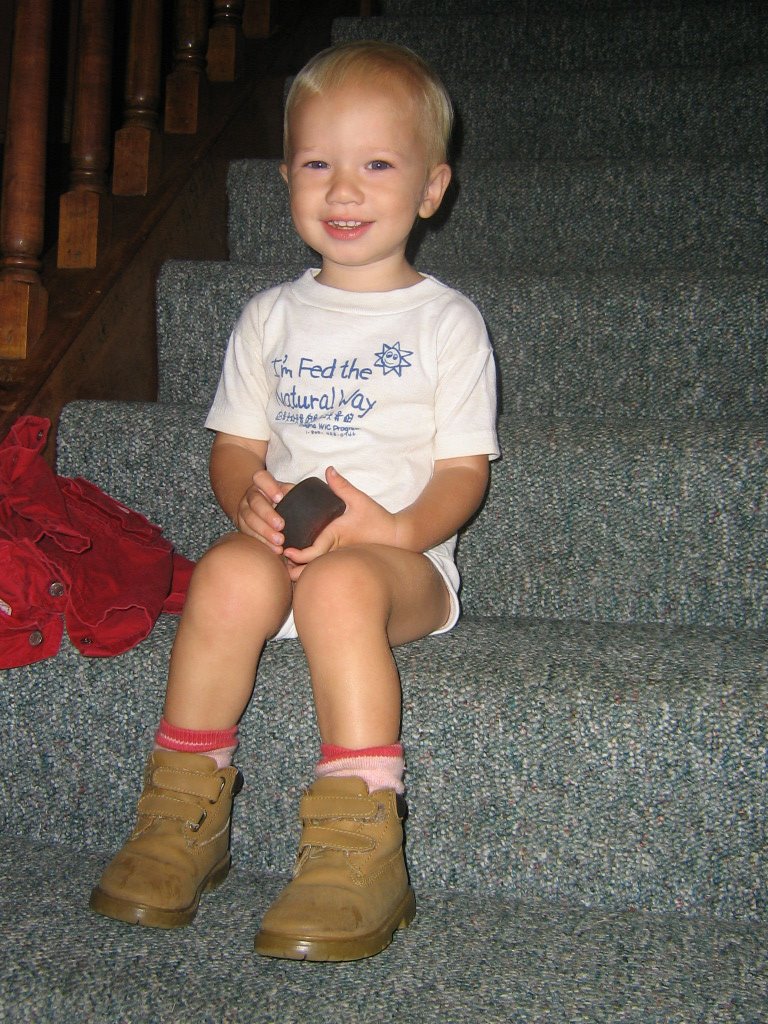
Sonny loves his hand-me-downs: Cousin Tyler's boots and Cousin Jonathon's "fuzzy pink socks". And, yes, that is a skateboard wheel he is holding. We have a slight obsession with all things rolling.
Tuesday, August 29, 2006
Trees for David
I talked to George Parker with the extension service. He is a silvaculturist at Purdue. He mentioned that the soil in Indiana is generally better for trees than it is for traditional farming, though it depends on the particular area. The benefits of planting trees include carbon sequestration, providing habitats for many useful species, protecting soil, and providing fuel and construction materials. It is curious to me why there isn’t more investment in such a wonderful product, especially in Indiana where it appears that we may have a comparative advantage in doing so.
The reasons that come to mind for me is that either it’s not profitable or that there is no financial mechanism set up to make it easy for people to do. On the first count, some of the benefits of trees are not taken into account by the market, so we may need some help from the government to make it more profitable. I understand that there are grants and subsidies for tree plantations, but perhaps they need to be augmented. On the second count, it seems that there is a problem with the lag time between when the plantation is planted and when it begins generate revenue.
If you think of a tree plantation in investment terms, it has an initial value based on an expected return at some time in the future. As the date of revenue generation gets closer, the value of the asset grows. Thus, value, if not income, is generated even before the first tree is harvested. Suppose we set up a cooperative where people could buy shares with either land or money. The money would be kept in a trust and used not just to plant the trees but also to run the plantation. The value of the shares would increase over time and eventually pay dividends once the plantation matured. Folks like Paul and Rosie could invest in such a cooperative with the land they have around their house, and folks like me and Jill could chip in the some of the capital necessary to maintain the plantation. If at any time we wanted out, we could just sell our shares at market value, incurring some profit from the investment depending on the projected market value of wood at the projected harvest date.
Such an investment would have both economic and environmental benefits. It would encourage investment in rural areas and stem suburban sprawl. With well placed plantations around Madison, it could raise the value of property in the city center as there becomes less available for development. Ultimately, this is good for the area; it would increase population density and drive down the energy costs per capita to live here.
Does such a mechanism as this exist already? How are current tree plantations funded? What is their profitability? What other obstacles can you see to the development of trees in rural Indiana? My initial research suggests that one could plant approximately 130 black walnut trees per acre, each worth about $4,000 and taking 35 years to mature. At that time, all the trees would be worth approximately $520K per acre. Dividing by 8% yearly income growth for that time period gives you a present value of $7,324 per acre. Add to this the present value of a continuous stream of income of $16,000 per year (from harvesting four trees per year). My college economics is a bit rusty; I forget how to do this calculation. I’m not sure if these numbers are accurate, and even so, I’m not sure if this would make it profitable. It seems on the low side to me. Perhaps you have some advice on the matter or some influence over political matters that would make such an endeavor be more feasible.
The reasons that come to mind for me is that either it’s not profitable or that there is no financial mechanism set up to make it easy for people to do. On the first count, some of the benefits of trees are not taken into account by the market, so we may need some help from the government to make it more profitable. I understand that there are grants and subsidies for tree plantations, but perhaps they need to be augmented. On the second count, it seems that there is a problem with the lag time between when the plantation is planted and when it begins generate revenue.
If you think of a tree plantation in investment terms, it has an initial value based on an expected return at some time in the future. As the date of revenue generation gets closer, the value of the asset grows. Thus, value, if not income, is generated even before the first tree is harvested. Suppose we set up a cooperative where people could buy shares with either land or money. The money would be kept in a trust and used not just to plant the trees but also to run the plantation. The value of the shares would increase over time and eventually pay dividends once the plantation matured. Folks like Paul and Rosie could invest in such a cooperative with the land they have around their house, and folks like me and Jill could chip in the some of the capital necessary to maintain the plantation. If at any time we wanted out, we could just sell our shares at market value, incurring some profit from the investment depending on the projected market value of wood at the projected harvest date.
Such an investment would have both economic and environmental benefits. It would encourage investment in rural areas and stem suburban sprawl. With well placed plantations around Madison, it could raise the value of property in the city center as there becomes less available for development. Ultimately, this is good for the area; it would increase population density and drive down the energy costs per capita to live here.
Does such a mechanism as this exist already? How are current tree plantations funded? What is their profitability? What other obstacles can you see to the development of trees in rural Indiana? My initial research suggests that one could plant approximately 130 black walnut trees per acre, each worth about $4,000 and taking 35 years to mature. At that time, all the trees would be worth approximately $520K per acre. Dividing by 8% yearly income growth for that time period gives you a present value of $7,324 per acre. Add to this the present value of a continuous stream of income of $16,000 per year (from harvesting four trees per year). My college economics is a bit rusty; I forget how to do this calculation. I’m not sure if these numbers are accurate, and even so, I’m not sure if this would make it profitable. It seems on the low side to me. Perhaps you have some advice on the matter or some influence over political matters that would make such an endeavor be more feasible.
Privatize Education
Privatize education. That’s the solution. The problem isn’t so easy to explain. Approximately 90% of school age children in the states of Indiana and Kentucky attend public school. But public schools are not all alike. Typically, the quality of the school—as well as of the student—correlates closely with family income.
The Center for Market and Public Organisation, a think tank from the United Kingdom, studied the degree to which schools were socio-economically sorted in districts with three types of school systems: Neighborhood school systems, where students were assigned to schools on the basis of where they lived; Privatized school systems, where students were given publicly funded vouchers progressively based on income; and school choice systems, where the district offered a fixed array of schools for parents to choose from. The study found that the greatest degree of socio-economic sorting occurred with the school choice model and that the least degree of socio-economic sorting occurred with the voucher school model. The difference between these two models was that the voucher system allowed schools to respond to market signals.
As many as 30% of our high school students fail to graduate. That’s a powerful commentary on the quality of our schools. In effect, they’re not just saying they want their schools to be better; missing school entirely is a better use of their time. Education is a personalized affair; the best learning environment will be different for different children. The private market model achieves the best results because it provides for the best matching between students and educational services. If you’re a parent, you want to write your state legislators and tell them to privatize education.
The irony is that our teachers are teaching better now than at any point in our history. There are tests, like the Brigance, that can screen kids as early as Kindergarten to determine who is likely to struggle with reading and what kinds of interventions will be necessary. The Woodcock-Munoz test can determine the degree of English proficiency a student has upon entering school. In decades past we may have labeled kids simply as slow or ornery; teachers now have the background and wherewithal to diagnose specific learning disabilities. At all levels, teachers know more about the human mind and the different factors that affect learning.
The problem for many public school teachers is that they are limited in the ways they can help children learn. We task them to teach solely to a narrow set of academic standards such that they are unable to teach other types of information that could greatly increase the learning and achievement of some students. In Indiana a teacher can start a Charter school for kids who might learn better in a different environment, but the school will then have little purview to select the students that the environment is designed for. Since Charter schools can’t charge tuition and state funding is limited, it is difficult for them to offer special services and still be profitable. Our current system limits the effectiveness of our teachers, as well as their wages and professional opportunities. If you’re a teacher, you want to write your state legislators and tell them to privatize education.
The problem with the current public education system is not that it fails to force poor and minority children to reach an arbitrary academic standard; the standards of excellence are too narrowly defined. The schools of poor children are bad because they fail to develop the strengths of their students. In many cases children do poorly on tests because of untreated learning disabilities. But many children do poorly simply because the tests hold no interest for them. Privatizing education will open the door to many new ways for students to earn intellectual credibility and meet their learning needs. If you’re a student, you want to write your state legislators and tell them to privatize education.
The Center for Market and Public Organisation, a think tank from the United Kingdom, studied the degree to which schools were socio-economically sorted in districts with three types of school systems: Neighborhood school systems, where students were assigned to schools on the basis of where they lived; Privatized school systems, where students were given publicly funded vouchers progressively based on income; and school choice systems, where the district offered a fixed array of schools for parents to choose from. The study found that the greatest degree of socio-economic sorting occurred with the school choice model and that the least degree of socio-economic sorting occurred with the voucher school model. The difference between these two models was that the voucher system allowed schools to respond to market signals.
As many as 30% of our high school students fail to graduate. That’s a powerful commentary on the quality of our schools. In effect, they’re not just saying they want their schools to be better; missing school entirely is a better use of their time. Education is a personalized affair; the best learning environment will be different for different children. The private market model achieves the best results because it provides for the best matching between students and educational services. If you’re a parent, you want to write your state legislators and tell them to privatize education.
The irony is that our teachers are teaching better now than at any point in our history. There are tests, like the Brigance, that can screen kids as early as Kindergarten to determine who is likely to struggle with reading and what kinds of interventions will be necessary. The Woodcock-Munoz test can determine the degree of English proficiency a student has upon entering school. In decades past we may have labeled kids simply as slow or ornery; teachers now have the background and wherewithal to diagnose specific learning disabilities. At all levels, teachers know more about the human mind and the different factors that affect learning.
The problem for many public school teachers is that they are limited in the ways they can help children learn. We task them to teach solely to a narrow set of academic standards such that they are unable to teach other types of information that could greatly increase the learning and achievement of some students. In Indiana a teacher can start a Charter school for kids who might learn better in a different environment, but the school will then have little purview to select the students that the environment is designed for. Since Charter schools can’t charge tuition and state funding is limited, it is difficult for them to offer special services and still be profitable. Our current system limits the effectiveness of our teachers, as well as their wages and professional opportunities. If you’re a teacher, you want to write your state legislators and tell them to privatize education.
The problem with the current public education system is not that it fails to force poor and minority children to reach an arbitrary academic standard; the standards of excellence are too narrowly defined. The schools of poor children are bad because they fail to develop the strengths of their students. In many cases children do poorly on tests because of untreated learning disabilities. But many children do poorly simply because the tests hold no interest for them. Privatizing education will open the door to many new ways for students to earn intellectual credibility and meet their learning needs. If you’re a student, you want to write your state legislators and tell them to privatize education.
Saturday, August 19, 2006
Sonny and Chief

Sonny pats Chief at Kentucky Lake. Note he never lets go of his new bus. We went the last week in July with Nat, Sean, Jonathon, Chief!, Paul, Rosie, David, Kay, Harlan and his friends, Tylor and Joey. Cousins Phillip and Mallory showed up to complete the crew.
Subscribe to:
Posts (Atom)


 Posts
Posts


